


South Indian Wedding Budget Breakdown: Real Costs Couples Should Expect in 2026
Planning a South Indian wedding in 2026? Check estimated costs for venues, catering, gold jewelry, and bridal attire in Chennai, Bengaluru, Hyderabad, and Kerala. Find budgeting tips to manage your expenses based on guest count and traditions without overspending.

Planning a South Indian Wedding accommodating a 300-500 guest count in 2026 typically costs between 10–25 lakh depending on the city and the community and the overall wedding scale. City specific variations are widely notable. That is why hosting a wedding in Kerala and Hyderabad are generally considered cheaper compared to hosting them in Chennai and Bengaluru.
A typical south Indian wedding has these non-negotiables to consider budgeting early: The venue, catering and gold. Gold in particular has seen a sharp rise in wedding budgets of 2026. Considering it being an integral part of Indian weddings for generations, it is valued both as a symbol of tradition and as a family asset. With its surge, it is becoming one of the biggest contributors to wedding expenses in 2026, especially in South India. 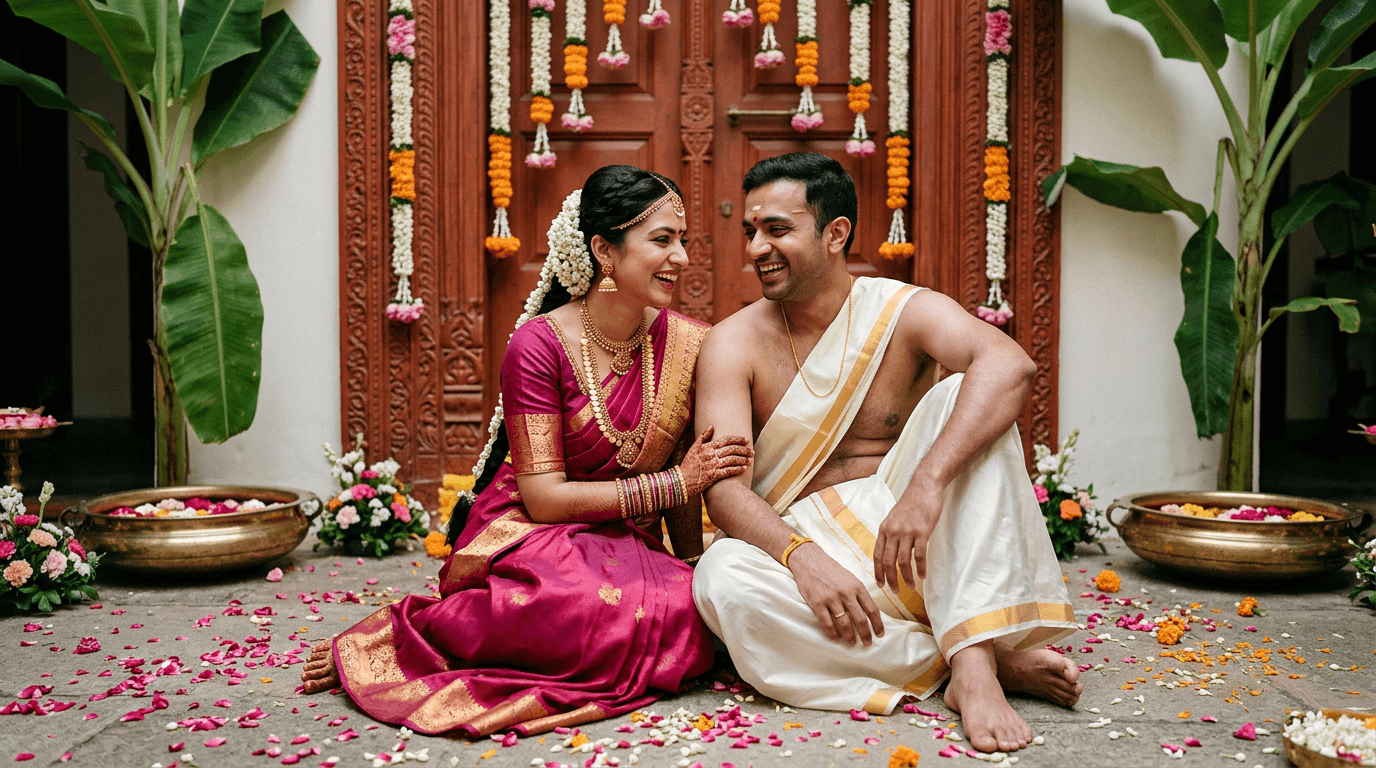
What Counts as a "South Indian Wedding" in 2026
When we talk about the cost of a South Indian wedding, it is important to clarify that there is no single, uniform budget benchmark that applies across the region. It is spread across four big cultural markets: Tamil, Telugu, Kannada and Malayali weddings, which include Hindu, Muslim and Christian ceremonies across the different states. Thus, all these celebrations do not have a single cost structure, but rather a widespread cost breakdown as per the ceremonies and customisation involved in each celebration.
A Chennai Brahmin wedding, a Hyderabadi Muslim nikah, and a Kerala Christian wedding can have very different budget drivers depending on rituals, guest count, jewellery expectations, venue formats, catering style, décor preferences, and the number of functions involved. Even within the same state, wedding costs can vary significantly based on community customs, city tier, and family scale.
This is where this blog comes in as a handy guide to know the estimated cost of a South Indian Wedding, as it is not confined to a single ceremony, culture, or state. Get to know the detailed average wedding budget in South India by region, community, and wedding style if you are planning your wedding in the upcoming months.
The 2026 Number: Why South Indian Wedding Costs Have Moved
The average wedding cost in India has risen significantly due to venue inflation, higher catering rates and the demand for a lavish, authentic and aesthetic wedding. As wedding inspirations grew, the demands grew even higher. A Mint report in 2025 noted that average wedding spending had climbed to around ₹32–35 lakh in 2024, reflecting a 28% increase over two years. As quoted earlier, gold prices too have surged to higher levels in recent years. As of July 2026, retail gold rates in India are around ₹1.46 lakh–₹1.48 lakh per 10 grams for 24K gold and roughly ₹1.34 lakh–₹1.35 lakh per 10 grams for 22K gold, depending on the city and seller. This is a major rise to note as gold has been part of the South Indian tradition for generations. It is worn as a thali along with other wedding jewellery, and prominently reshapes how wedding budgets are planned in recent years.
City-by-City Cost Breakdown of a South Indian Wedding
The wedding budget varies with respect to different states in South India based on the venue rentals, area, and other additional cost drivers. Here is an estimated breakdown of a state’s wedding budget, based on localities, venue rentals and overall wedding expenses.
City / Region | Common wedding localities
| Venue pricing benchmark | Overall wedding budget* | Major cost drivers |
Chennai | Mylapore, T. Nagar, Anna Nagar, Vadapalani, ECR, Guindy | ₹1–20 lakh+ across marriage halls, hotel banquets, and luxury venues | ₹18–45 lakh+ | Large guest counts, catering scale, gold purchases, multi-function weddings |
Coimbatore / Madurai | Avinashi Road, RS Puram, Peelamedu / KK Nagar, Mattuthavani, Ring Road | ₹75,000–10 lakh+ depending on hall vs hotel format | ₹12–28 lakh+ | Large family guest lists, catering, jewellery, multiple meal functions |
Bengaluru | Hebbal, Yelahanka, Whitefield, Palace Road, Sarjapur | ₹1.5–25 lakh+ across banquet halls, convention venues, and luxury hotels | ₹20–50 lakh+ | Higher venue rentals, décor, hospitality, cocktail/event add-ons |
Hyderabad | Banjara Hills, Jubilee Hills, Gachibowli, Kompally, Shamshabad | ₹1–25 lakh+ from function halls to premium hotel weddings | ₹18–55 lakh+ | Venue scale, catering, jewellery, hospitality, multiple events |
Kerala (Kochi / Kottayam / Thrissur) | Maradu, Bolgatty, Kumarakom, Kottayam town, Thrissur city | ₹75,000–15 lakh+ across auditoriums, hotels, and resort venues | ₹15–35 lakh+ | Venue format, catering, guest accommodation, photography, jewellery |
Where the Money Actually Goes: Category Breakdown
A South Indian wedding has multiple categories and prior budgeting is expected to land on cost-effective, fair pricing. Here is a typical spend range for such categories for a South Indian Wedding in 2026, and what all it usually covers.
Cost category | Typical spend range (2026) | What it usually covers |
Venue | ₹75,000 – ₹25 lakh+ | Temple hall, kalyana mandapam, hotel banquet, or convention venue rental |
Catering | ₹250 – ₹2,500+ per plate | Breakfast, lunch, dinner, snacks, service, banana leaf meals or buffet setup |
Gold & Jewellery | ₹5 lakh – ₹40 lakh+ | Bridal jewellery, family gifting jewellery, wedding gold purchases |
Bridal Sarees & Wedding Shopping | ₹1 lakh – ₹8 lakh+ | Muhurtham saree, reception saree, blouse work, additional function sarees |
Groom Attire | ₹25,000 – ₹2 lakh+ | Veshti, sherwani/suit, reception outfit, footwear, accessories |
Photography & Videography | ₹1 lakh – ₹6 lakh+ | Candid photography, traditional coverage, wedding films, albums |
Décor, Mandap Setup & Traditional Music | ₹1 lakh – ₹10 lakh+ | Floral décor, stage setup, mandap décor, lighting, nadaswaram / melam |
Priest Fees & Ritual Materials | ₹15,000 – ₹1 lakh+ | Dakshina, homam materials, pooja items, garlands, ceremony essentials |
Note: Indicative 2026 planning ranges for South Indian weddings; actual spend varies by city, guest count, community customs, and number of functions.
Hidden Costs Couples Consistently Miss
Even couples who plan venue, food, and jewellery budgets carefully often underestimate the final wedding bill because of a handful of costs that rarely show up in the first quote. South Indian Weddings have multiple extra expenses that we need to look out for prior to avoiding last-minute surprises. It is linked to peak season price rates, gold making charges, guest gifting, travel and backup logistics. These additional costs don’t sound huge in isolation, but can collectively add several lakhs to the total wedding budget.
5 Hidden Costs to Know Ahead in South Indian Wedding Budget Planning
- GST charges on venue and catering
Base venue rentals and the catering services often look manageable in the initial quote, until 18% GST is added to rental, banquet packages, or catering bills.
- Peak season muhurtham charges
Popular auspicious weekends and Friday muhurthams can push venue and vendor pricing 20–30% higher than off-date bookings. If possible, picking an off-season wedding date helps in planning this cost better.
- Gold making charges
Families often budget for the gold rate but forget that making charges, wastage, and design premiums can add 8–25% over the metal value.
- Return gifts for guests
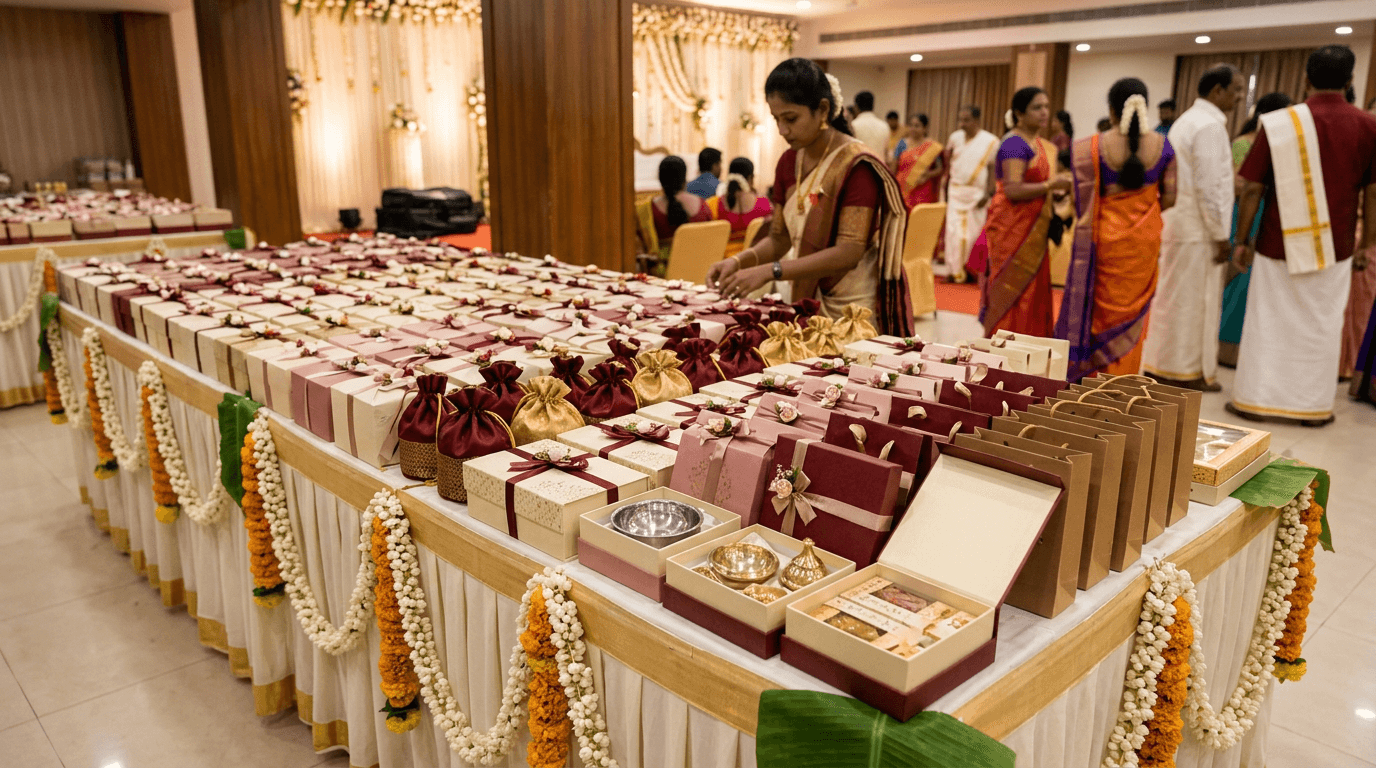
This is a common practice in South Indian weddings. This is often prioritised as the last expense or planned along with the catering budget. But they add a substantial charge to the overall wedding bill, which cannot be underestimated. Many couples prefer to give customized return gifts to their guests, which has to be curated early to manage the expense. To manage the cost, some couples now explore curated or sponsored wedding gift box services instead of self-funding every return gift entirely. In fact, if this is something that’s part of your wedding budget stress, explore our curated wedding gift boxes from WeddingGiftBox, which are designed to help couples curate and plan the cost of tambulam and guest gifting.
- Power backup, logistics, and vendor travel
This is a possible expense for temple weddings, outdoor venues, or destination-style events where generator backup, stays, and transport for decorators, photographers, musicians, or makeup artists can become a meaningful add-on.
Community and Ritual-Specific Cost Differences
As everyone knows, South India is culturally inclined with community-specific rituals and event structures. For example, a Tamil Brahmin wedding has events like Nichayathartham, Kashi Yatra, Oonjal, and the wedding ceremony. Weddings from other communities vary by the community-specific rituals and functions involved.
In Telugu weddings, especially among Reddy and Kamma families, the budget often expands because the wedding is spread across multiple visible events rather than just the muhurtham itself. Functions such as Pellikuthuru and Pellikoduku, engagement, reception evenings, and large-scale hospitality for extended family can easily increase the required decor arrangements, catering costs, photography, and outfit costs even before the main wedding day.
In Kerala, Hindu Nair weddings are considerably shorter and more compact as per ritual, but there is a major gold expense, which requires a chunk of budget planning. Syrian Christian weddings normally cost more in Kerala because it combines church ceremony expenses, bridal styling, reception, hall booking and additional charges. Muslim weddings are also common in Kerala, which include Nikah and Walima along with guest hospitality, food, and extra accommodation arrangements if required.
In Karnataka, Vokkaliga and Lingayat weddings can differ meaningfully in both scale and event flow depending on the family and region. Generally, the biggest budget differences usually come from guest count, number of functions planned, catering services for guests, and silk/jewellery shopping, rather than from rituals alone.
How to Trim the Budget Without Cutting Corners
Planning a wedding on a strict budget isn’t just about cutting costs — it’s about making a few smart decisions early enough to keep the overall spend under control. The strategies below are not generic wedding tips, but practical ways to save meaningfully without compromising the celebration itself.
- Planning your wedding on an off-season wedding date to reduce venue costs and possibly land on discounts and complimentary amenities.
- Choosing temple-style weddings compared to renting a wedding hall helps reduce the venue cost and can be spread across other expenses.
- If a traditional engagement ceremony is planned, pairing it with the main wedding ceremony can help cut down on one separate event, which includes exclusive catering and decor arrangements.
- Renting wedding jewellery, lehengas, reception gowns, and suit sets instead of buying a full bridal trousseau helps in managing the budget set aside for these expenses.
- Planning the guest count ahead, prioritizing the head count, travel, and accommodation arrangements specific to each event.
- Using digital wedding cards to invite extended relatives and friends helps in reducing invitation print counts and the added travel and hospitality arrangements.
Budgeting for Return Gifts and Tambulam
Wedding return gifts are part of the South Indian tradition, and it ranges from different budgets.
Since it is usually given per guest family rather than per invitation, even a modest budget of ₹250–₹500 per family can quickly add up to ₹50,000–₹1 lakh or more at a mid-sized wedding. Curated wedding gift boxes are also part of current wedding trends for couples looking for customized gifting options.
What kind of a South Indian Wedding suits you?
There is no single “right” way to host a South Indian Wedding. However, here are three extensive categories to explore, based on your wedding inspirations, guest count, and budget.
A temple or registered wedding with a simple after-party celebration may be the right fit if you want an intimate wedding celebration with a minimal guest count and a strict budget. It is also a wise choice if you are selective about photography, gold, or catering.
A mid-range hall wedding may fit best if you plan to host a traditional South Indian wedding celebration, with an elaborate guest list and multiple rituals. However, planning this wedding on a budget requires smart planning, off-season booking, and working early on priorities to stick to the estimated expenses.
A large multi-day wedding celebration may fit you if you wish to have an elaborate, multi-day wedding celebration. This requires intensive planning for multiple decor arrangements, catering setups, accommodation, transport arrangements, and other important logistics. Generally, the budget here exceeds the planned number, depending on how elaborate each event is.
Final Thoughts
The average wedding cost in India is shaped by a combination of city, community, guest count, gold purchases, catering scale, and the number of functions planned. A South Indian Wedding is now not just about planning a venue, but includes more than that. Most importantly, it is important to understand that there is no single correct way to host a South Indian wedding. The right event structure is the one that fits your priorities, your family’s expectations, and the budget you can comfortably manage.